
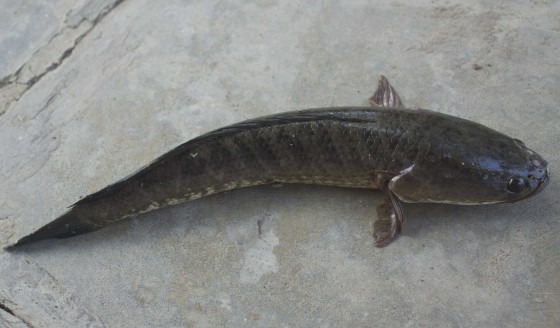
Is the Snakehead fish (“Frankenfish”) an ecological scourge for North American native species of fish?
The ecological impact of the Snakehead (“Channa Argus”) on native species seems to not have had such a huge impact up to this point according to biologist John Odenkirk.
The reason for their bad reputation is due to some impressive traits that the fish exhibits.
The fish are extremely strong, can breathe air and can slither small distances on land. Because of these inpressive traits many state’s environmental agencies have placed kill orders on the fish.
Last April Snakehead fish were reported to be in New York Central Park’s lakes and ponds prompting the New York State Department of Environmental Conservation to state, “If you catch one, DO NOT RELEASE IT. Kill it immediately, freeze it and report your catch.”
Biologists are divided on invasive species of animals or non-native species or NNS.
In the Journal of Agricultural and Environmental Ethics Journal of Agricultural and Environmental Ethics (2005) 18: 595–607
DOI 10.1007/s10806-005-2851-0, Daniel Simberlofff argues that non-native species do threaten the natural environment. He does this by citing a paper by Sagoff that was introduced to the Journal of Agricultural and Environmental Ethics in 2005.
He basically says that those who argue that non-native species (NNS) are not threatening to native species do so by tautological arguments. Meaning they argue, “It’s either harmful or it’s not, but we have no way of knowing.”
This, according to Simberloff, is not enough to justify non-action in eradication of invasive species.
Here is a portion of his article,
The fifth problem Sagoff (2005) describes for the view that NNS causeenvironmental harm is that the very definitions of certain phenomenathey are sometimes said to harm – biodiversity, ecosystem health andintegrity, the balance of nature – are ill-defined and may even be construed in such a way that a claim of harm from NNS may be tautological. I partially agree. The definitions of ecosystem health andintegrity, and the balance of nature, are value-laden and subjective(Simberloff, 1980; Simberloff, 1998; Parker et al., 1999), and claims thatNNS damage them are indeed in danger of being tautological. That is,the very definition of ‘‘ecosystem integrity’’ or ‘‘ecosystem health’’ can,and sometimes does, entail absence of substantial populations of NNS.Similarly, the balance of nature is frequently claimed to be upset byintroduced species, but just as ‘‘natural’’ is often problematically conceived by definition to exclude NNS, or at least NNS introduced byhumans (see, e.g., Cronon, 1996; Burdick, 2005), so can a balanced natureeasily be defined to exclude them.
Biodiversity is another matter. It has both broad and narrow technicalmeanings (US Congress Office of Technology Assessment, 1987). The broadtechnical meaning is diversity at three levels – genetic, species, and community or ecosystem. For want of means to measure genetic and communityor ecosystem diversity (although rapid progress has been made recently onthe genetic front), by default most scientists when discussing biodiversity ina technical context are referring to species diversity, and almost always tospecies diversity as expressed simply by species richness, the number ofspecies. As discussed in the above section, ‘‘Biodiversity, species richness,and ecosystem function,’’ NNS do affect species richness, both globally andlocally; it is not tautological to say so. Neither is it tautological to say anNNS affects biodiversity when biodiversity is explicitly stated to mean native species richness, as by Sala et al. (2000). Somewhat more problematic isthe contention that NNS affect native biodiversity, by which is meant nativespecies richness, when ‘‘native’’ is implied but omitted as a modifier of‘‘biodiversity’’ (e.g., Muller, 2004). At least in scientific writing, it is almostalways possible to determine from context what is meant, but in publications for a lay audience this is sometimes not so clear.
The bigger problem in lay writing is that ‘‘biodiversity’’ has come to bean exploded metaphor for all of nature, no doubt because its connotationsin this context include political, social, and even ethical values. It islamentable that writing for a general audience sometimes simply states thatNNS harm biodiversity, in this vague sense, particularly when explicitexamples of harm are not given. However, the existence of imprecise writingof this sort in no way invalidates the many well-defined and verified cases ofenvironmental harm caused by introduced species.
Paul Angermeler, a scientist at the U.S. Geological Survey says “it’s still quite early, adecade or so isn’t long for an invading population to really wreak havoc on things.”
Meanwhile Washington seafood wholesaler John Rorapaugh says his company pays $4 to $5 per pound for snake head meat. The meat is growing popular with chiefs because of it’s mild flavor and firm texture.